


.png?width=1200&name=Heading%20(3).png)
As a leading provider of Facilities Management qualifications in Ireland for over a decade, Portobello Institute is proud to support the recognition of personal and professional development across the sector through the Facilities Management Awards 2026.
Returning on 11th March at the Royal Convention Centre Dublin, the awards bring together leaders from Ireland’s facilities and property management industry to celebrate excellence, innovation and achievement. Since 2014, the event has recognised high-performing teams and organisations, with winners selected by a panel of senior industry leaders and academics.
Portobello Institute is delighted to sponsor the People Development in Facilities Management Award, which recognises organisations demonstrating an outstanding commitment to investing in their people and building strong, future-focused teams.
The shortlisted finalists in this award category are:
-
Flexeir Facilities Services with 'Elevate'
-
Apleona Ireland with 'Academy for Growth and Centre of Excellence
-
ISS Facilities Services Ireland with 'Placemaker's Pathway'
-
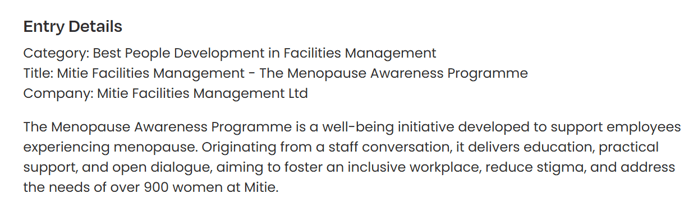
Mitie Facilities Management Ltd. with 'The Menopause Awareness Programme'
- Sodexo Ireland with 'Promote from Within'
You can read more about all of the shortlisted projects here.
Supporting professional growth and wellbeing is central to the long-term success of the FM sector, and initiatives that prioritise people create more inclusive, resilient workplaces.
At Portobello Institute, we are proud to support professionals at every stage of their career through internationally recognised qualifications in Workplace and Facilities Management, from IWFM Level 4 and IWFM Level 5 Diploma through to BSc (Hons) Workplace & Facilities Management, Postgraduate Certificate and MSc Workplace & Facilities Management programmes awarded by London Metropolitan University.
These programmes enable FM professionals to deepen their expertise, progress into leadership roles and drive innovation across the industry.
-1.png?width=566&height=354&name=Untitled%20design%20(46)-1.png) Portobello Institute at the FM Awards in 2022.
Portobello Institute at the FM Awards in 2022.
Interview with Mitie - Shortlisted for Best People Development at Facilities Management Awards 2026
As part of this year’s awards, we spoke with Mitie, nominated for their Menopause Awareness Programme, an initiative that demonstrates how organisations can create supportive environments that prioritise wellbeing, inclusivity and understanding in the workplace.
In this interview, the team at Mitie shares how the programme began, how it evolved into a structured wellbeing initiative, and the impact it has had on workplace culture and employee support.
How did this Menopause Awareness Programme come about and what prompted its development?
The Menopause awareness programme originated from informal staff discussions which led to a small group initially approaching the People Director at Mitie to see what supports could be put in place. This led to some formal research of the impact of menopause in the workplace.
Research from the Menopause Hub in 2023 shows the bigger picture of how much it impacts women in the workplace and how it can create challenges for peri/menopausal women. From the thousands of respondents in this research, 84% said they were negatively impacted by symptoms in work, 38% took time off work due to symptoms, and 34% were considering giving up work with 10% actually doing so.
The scope of this is something that every company should consider when looking to support staff welfare, and the desire to have a more inclusive and understanding work environment gave us further impetus to get this programme up and running.
It was clear that one of the first actions was an awareness and education programme needed to be put in place for all People Managers, with this in mind Mitie engaged a company called The Wellness Warrior, and Catherine was the first official menopause coach in Ireland and she delivered awareness class to all Mitie’s 115 people managers from the MD down.
How did you move from initial staff dialogue to a structured wellbeing initiative?
On the back of the training, we ran a recruitment campaign for Menopause Champions (MC), who would like to get involved in helping support other staff, and rolling out initiatives and support to all our teams.
The MCs are from across a variety of contracts and support functions and meet regularly to plan and develop what we will do. We have the backing and support of senior management which has been a great bonus in allowing us to fully provide more information and support to staff.
What practical supports or education elements have had the greatest impact?
We sent a survey to all staff to gauge the biggest factors impacting them at work. This has allowed us to focus on taking more practical steps for support and signposting.
One of the initiatives was ordering lighter, and cooler, uniform tops for staff who may need it. We have had orders in from staff all around the country and it has gone down well.
We now provide desk fans for anyone in head office who may need some relief from hot flushes in the office.
We have started getting emergency packs prepared that we can send to some staff working off site and not based in head office. These have a small supply of helpful items such as wipes, cool pack, and deodorant.
There are now regular Menopause Cafes that we host in person and virtually. It is time dedicated to informing people on the full impact of the menopause and what symptoms may impact staff and what practical support can be given to our teams, as well as having a cuppa and a chat in a safe environment.
We are also going to be bringing the Menopause Cafe on the road and visiting a variety of sites where our staff work to help continue to roll out the message of understanding of the impacts on our staff.
How has the programme contributed to creating a more open and inclusive workplace culture?
Our menopause cafes are held regularly, and there are multiple opportunities for anyone to drop in and find out more. It has created a more positive understanding of menopause, and of women's health in general.
At the café, we held around World Menopause Day, we created a more immersive experience created to highlight the physical impacts of symptoms.
For example, a tens machine was used to show how painful periods can be, particularly for a lot of women in perimenopause. It allowed for staff without uteruses to experience cramping and pain and then they were posed questions such as 'Could you handle this if it was during a client meeting? Or 'How do you think you feel if you had cramps for several days in a row and are expected to continue on doing everything you normally do?' which really illustrated the how it can impact every part of life.
We also used quizzes to replicate brain fog, and a hot room to illustrate instant changes in temperature. It was one of our best attended cafes and saw eager participation from staff who also learned more about all things menopause.
What measurable or observable changes have you seen since its introduction?
The fact that orders for cooler uniform tops continue to come in shows an ongoing need. Uptake of fans in the office is good and really help, particularly in warmer weather. Staff provisions in toilets are not just limited to period products but also includes items such as deodorant, wipes, and moisturiser.
Continued regular attendance at our menopause cafes which are open to all staff, whether they are someone in any stage of menopause or not, has definitely helped increase understanding among the broader staff population.
What has been the most important lesson in addressing menopause in the workplace?
Increased knowledge of the menopause and how it affects people has been very positively received. There is still a huge lack of understanding in the general population on what menopause actually is, the different stages, and what each of these can bring with them.
Being able to show people the scope of the menopause, and what can be done to help, not only helps staff in work, but broadens their knowledge in every aspect of their life, including what friends or family may be going through.
What advice would you give to organisations looking to create supportive environments around wellbeing topics?
Research, research, research. There are so many elements to the menopause, and the range of symptoms is huge. Making sure you have found the right services to signpost for support is important, as misinformation is always a problem.
At the end of the day, MCs are not medical professionals but are there to signpost to the right services and support.
Never underestimate the lack of knowledge around menopause. A huge amount of time will be spent giving people basic information of what menopause actually is, and what symptoms could be. Women also need to be supported in advocating for themselves medically, as even GPs have limited knowledge and training, and may not be up to date in developments in diagnoses and treatments.
Another vital element is the understanding that the menopause can look different for every woman. Not everyone has the same lived experience so what one person understands or sees, is not guaranteed to be the same for the next person.
I think it's fantastic that the menopause awareness programme has been nominated. It again is another way to highlight how prevalent menopause is and how the 80% of women who have symptoms are often living in an information void.
If you understand that perimenopause can last up to ten years and then post-menopausal changes can take another few years to settle, there is a large portion of a woman's working life that can be lived in the shadow of menopause.
Working to increase awareness and support for staff is really important to ensure we can continue to keep our workplaces an inclusive and informed one. That this has been recognised and nominated is a great sense of pride and will help keep motivating us to continue on with the menopause awareness programme.
A Powerful People Development Programme
Mitie’s Menopause Awareness Programme highlights the meaningful impact organisations can have when they listen to their people and respond with practical, thoughtful support.
By combining education, open conversation and tangible workplace adjustments, the initiative demonstrates how wellbeing programmes can strengthen workplace culture while empowering employees at every stage of their career.
As the facilities management sector continues to evolve, initiatives like this show that investing in people is not only the right thing to do, but a key driver of inclusive, resilient and forward-thinking organisations.
Portobello Institute is proud to sponsor the Best People Development Award at the Facilities Management Awards 2026 acknowledging and positively promoting work initiatives like Mitie's.
Follow us on LinkedIn for updates on the Facilities Management Awards 2026 and more. Visit our Facilities Management faculty for course information.
-1.png?width=352&name=Heading%20(3)-1.png)
-2.png?width=352&name=Heading%20(3)-2.png)