


-1.png?width=1200&name=Untitled%20design%20(18)-1.png)

If you work in the early years sector in Ireland you may be wondering what courses are funded by the Nurturing Skills Learner Fund in 2026?
Portobello Institute is participating in the Nurturing Skills Learner Fund Scheme (NSLF) to help early years educators upskill.
The courses covered by the Nurturing Skills Learner Fund Scheme at Portobello Institute include:
- BA (Ord) Early Childhood Education & Care - 2 Years (Level 7) - starts October 3rd 2026
- BA (Hons) Early Childhood Education & Care - 3 years (Level 8) - starts October 3rd 2026
In order for you to choose the right course for you, let's delve into more detail on these qualifications.
The BA (Ord) Early Childhood Care and Education degree, awarded by the University of Essex, is delivered through blended learning, enabling you to work full-time while studying.
Graduates are eligible for the Graduate Premium from DCEDIY for roles in early years settings.
Your work placement hours can be completed within the setting that you are employed in.
The programme is delivered by online learning over two academic years with one-to-one tutor support, accommodating your work-life balance.
The sector is moving rapidly towards a graduate-led workforce and this degree is your opportunity to keep up with those changes.
Upon successful completion, you will be open to new career opportunities and eligible to apply for more diverse roles such as those within community projects and public health.
The programme meets the Professional Award Criteria and Guidelines standards set by the Qualifications Advisory Board (QAB). It is also recognised by DCEDIY for the Graduate Premium.
Upon completion, you will hold a BA (Ord) in Early Childhood Care & Education from the University of Essex, aligned with level 7 on the National Framework of Qualifications (NFQ).
What is the difference between BA (Ord) level 7 and BA (Hons) level 8?
The level 8 qualification shares the same first two years with the BA (Ord) level 7 degree, the difference is that you continue on to an additional third year to complete the Honours degree level.
The final year takes you a step further, qualifies you for roles with organisations such as Pobal, Better Start, Tusla, DCDE, the Ombudsman for Children's Office and other roles involving policy development, innovation, leadership and change in the sector.
It is suited to people who are thinking about their future in childcare, and roles outside of the setting and working with children. It is also suited to those who own or lead childcare settings who want to deepen their knowledge to offer the best practices possible to the children they work with.
The third year includes a research project you can do in your current work setting.
This work-based programme enhances critical thinking, research skills, and professional practice, including a research project on a relevant topic that you are interested in. You have the opportunity to explore a topic of interest with Portobello's expert tutor support.
This is a valuable learning experience enhanced by small classes, draft assignments, and individual module tutors.
Graduates receive a BA (Hons) Early Childhood Studies from the University of Essex, recognised at level 8 on the National Framework of Qualifications, meeting the Professional Award Criteria for Early Childhood Care and Education.
Holding a level 8 degree open the opportunity for you to progress onto postgraduate studies in an are that you are interested which could be anything from an MA Inclusive Education and SEN to an MSc Speech and Language Therapy.
What Our Students Say
Anne Marie Dalton from Meath is studying for her BA (Hons) Early Childhood Care and Education degree at Portobello Institute, with 15 years of experience, this is the ‘missing piece of the puzzle’ to align her experience with her qualification level.
“I am a parent of three and have fifteen years of experience working in early years education. I believe that this experience cannot be replaced or overstated. I know that every child, family and staff member I encountered along the way taught me something and the education through experience never stops.
“I gained knowledge and confidence through studying for Level 5 and Level 6, particularly the theory behind why we do what we do. Armed with this theory, defending concepts that are important for young children was easier to advocate for.
“Examples like the key person system, the right to play, hierarchy of needs empowered me to be better in my role and to be unapologetic when it comes to striving for the best outcomes for children. It’s logical that the more education that I receive, the better I can be at my job and better the experiences that the children in my care will receive,” she said.

Marcella McNamee’s journey back into education was shaped by determination, responsibility, and a deep commitment to the children and families she serves. Balancing two early years services, a demanding leadership role, and life with five children made returning to study a significant undertaking, yet it became one of the most transformative decisions of her career.
Marcella’s passion for education did not begin with encouragement. At 19, she completed a course in Health and Social Care but struggled with dyslexia. She still remembers the words from the meeting that could have ended her educational journey entirely.
“You will never succeed in the academic world. My advice is to get a secure job in a shop or a factory, because that’s all you will ever be capable of,” she says.
Instead of accepting those words, Marcella turned them into fuel. They became an anchor, a reminder that no child or young person in her care would ever be made to feel small, incapable or dismissed. She refused to let someone else define her future.
“I became determined that no young person or child in my care would ever be made to feel that way about themselves, not by me, or by anyone working in our service,” she says.
That early moment of discouragement shaped her purpose: to grow, to lead, and to create environments where every child and every educator feels valued, capable and supported.
"Completing the Level 8 programme was a pivotal milestone for me. It not only strengthened my academic confidence but also deepened my understanding of leadership, practice, and inclusion within the sector.
"Portobello provided flexible, well-structured classes that allowed me to continue working while progressing academically.
"The lecturers were incredibly supportive, approachable, and genuinely invested in their students’ success.
"I was never made to feel like ‘just another student.’ Instead, I felt seen. Portobello created an environment where I could succeed," she said.

Why Upskill in Early Childhood Care and Education?
One-third of the early years sector working directly with children now holds a level 7 degree or higher.
The proportion of staff with a qualification at level 7 and above increased significantly from 26.6% in 2019/20 to 33.2% in 2021/2022 - a 6% increase.
According to Nurturing Skills: The Workforce Plan for Early Learning and Care and School-Age Childcare, 2022-2028 the purpose of the NSLF is to develop "a well-qualified, skilled, diverse and valued professional workforce that is centred on children’s rights, needs and potential and that provides quality experiences for children in partnership with families, and which continues to advance its professional development within a coherent and competent system.”
Keeping up with the professionalisation of the early years sector in Ireland is beneficial for a number of reasons:
- Improved Quality of Care and Education – Ensures higher standards in early childhood care and education benefiting children’s learning and development.
- Enhanced Child Outcomes – Supports better cognitive, social, and emotional development in young children.
- Increased Recognition for Practitioners – Strengthens the professional status of early years educators, leading to greater respect and career opportunities.
- Higher Standards and Regulations Compliance – Ensures alignment with national frameworks like Síolta (Quality Standards) and Aistear (Curriculum Framework).
- Better Pay and Working Conditions – Contributes to improved wages, benefits, and job security for early years professionals.
- Access to Professional Development – Encourages continuous learning and upskilling through training and qualifications.
- Parental Confidence and Trust – Provides assurance to parents that their children are in safe, high-quality learning environments.
- Attracting and Retaining Skilled Educators – Helps retain experienced staff and attract new talent to the sector.
- Alignment with Government Policies – Supports national goals for early childhood education and care, increasing investment and support from policymakers.
- Long-Term Societal Benefits – Contributes to a well-educated workforce, reduced social inequalities, and economic growth in the future.
How Do You Apply for NSLF? Step by Step Guide:
Your application to Portobello Institute and your application for NSLF are two separate processes.
Step 1: Your application to Portobello Institute and your application for NSLF are two separate processes.
Step 2: Apply for your chosen course: BA (Ord) Early Childhood Care and Education or BA (Hons) Early Childhood Care and Education.
Step 3: You'll hear from our team with more information and support. You will be asked to complete your application and pay a deposit to hold your place with us while your NSLF application processes.
Step 4: Once the previous steps have been successfully completed, Portobello Institute will issue you with confirmation of your application. You will submit this confirmation as part of your NSLF application.
Step 5: You will be asked to submit evidence of your level 6 qualification and some other eligibility checks will be reviewed.
Step 6: Upon approval for entry onto Portobello Institute's course you will be registered on the degree pending NSLF funding approval and full deposit payment completion. If you are unsuccessful with your application to Portobello Institute or NSLF we can arrange a deposit refund or discuss payment options with you.
Important Note: Your application to study at Portobello Institute and your NSLF application with Pobal are two different things. It is expected that from mid-March 2026, applicants wishing to avail of the fund will be able to email Pobal, at NSLF@pobal.ie to request a link to the NSLF Student Portal in order to create an account and upload employment details and complete the NSLF application process.
You can start your application with Portobello Institute at any time.
Register Your Interest
If you are considering starting your degree in October 2026 and applying for NSLF funding, complete the form below and our course advisors will guide you through the next steps.
If you have any questions, you can contact:
Limin Bai
limin.bai@portobelloinstitute.com
01 233 8490
You can also book a call here.
Portobello Institute Graduate Success Stories
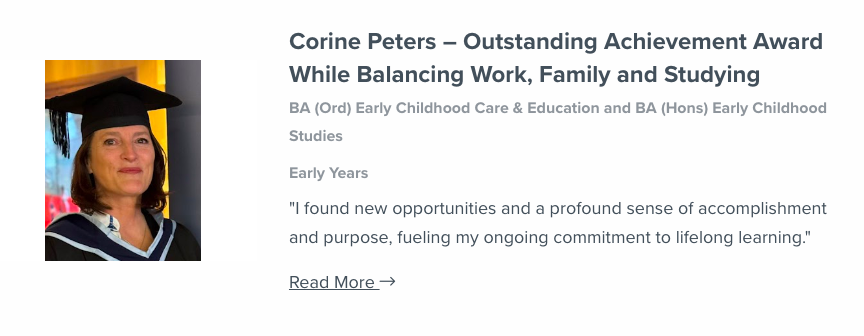
Read Corine's Success Story here.
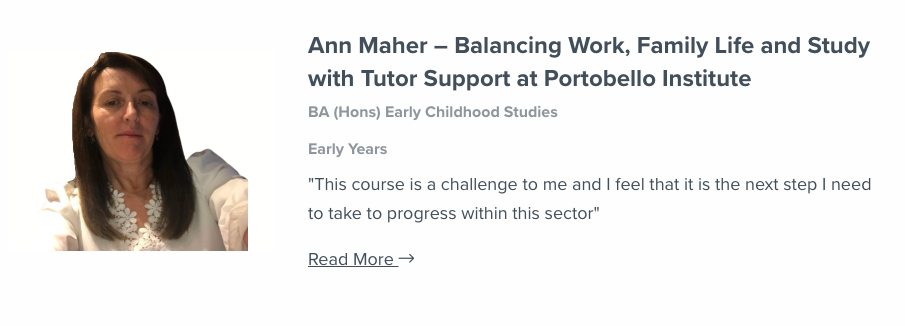
Read Ann's Success Story here.
.png?width=352&name=Feature%20image%20(1).png)
.png?width=352&name=Feature%20image%20(5).png)